Written by Trust Law Legacy Group, APC, an Estate Planning, Trust & Probate Law Firm in San Jose, California. Updated June 2026.
Table of Contents
- The Quick Answer
- A California Icon’s Final Years
- What Brian Wilson Got Right
- The One Gap That Led to a Conservatorship
- What a Conservatorship Actually Means in California
- The Four Documents That Keep Your Family Out of Court
- Why ‘Name a Backup’ Is the Most Overlooked Step
- Update Your Plan After Every Major Life Event
- Frequently Asked Questions
- Protect Your Own Legacy
The Quick Answer
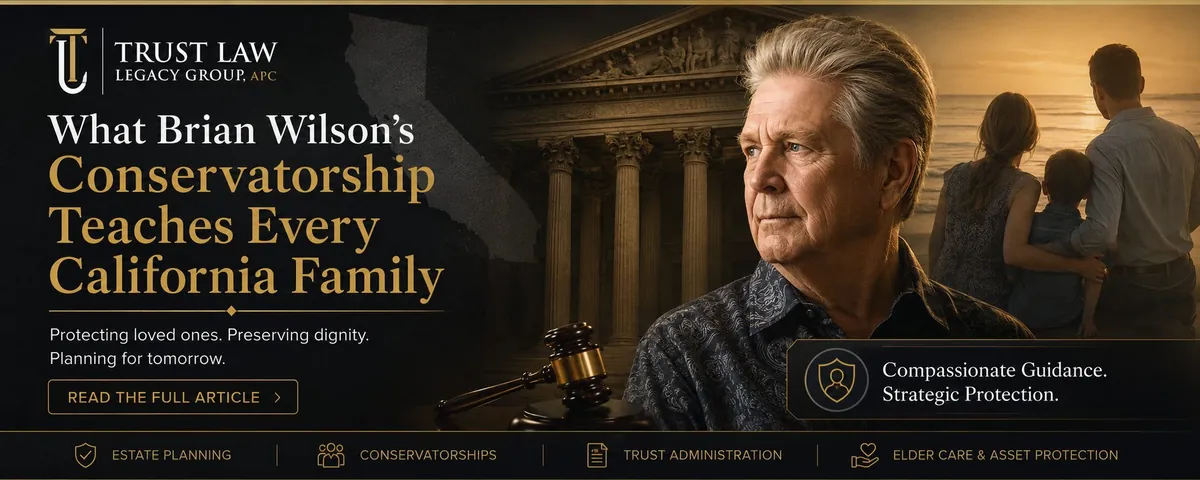
Brian Wilson, the creative force behind The Beach Boys and, for a lot of us, the actual sound of California, passed away on June 11, 2025, at age 82. In his final years he lived under a court-ordered conservatorship. The surprising part? Wilson had actually done a lot right: he held his assets in a revocable living trust, which kept his finances private and out of probate.
So how did a man with a trust still end up in conservatorship court? Because a living trust does not cover medical and personal decisions, and the document that should have, his Advance Health Care Directive, named his late wife as his agent without naming a backup. As a result, when she passed, there was no one legally allowed to step in, and a judge had to appoint conservators.
The lesson for every California family is simple and a little uncomfortable: a trust alone is not a complete plan. Importantly, you also need incapacity documents, with named successors, that you keep current.
A California Icon’s Final Years
Indeed, Brian Wilson’s life was California through and through: Hawthorne kid, Capitol Records studios, the harmonies that defined a generation of summers. Therefore, it carries real weight that the legal story of his final chapter played out in a Los Angeles courtroom.
After his wife and longtime caregiver, Melinda Ledbetter Wilson, died in January 2024, Wilson’s health declined quickly. Court filings described a ‘major neurocognitive disorder’; he was being treated for dementia and, according to the petition, was no longer able to provide for his own basic needs. In May 2024, a Los Angeles judge placed him under a conservatorship of the person. The judge named two people who had been close to him at work, his longtime publicist and his business manager, as co-conservators.
He lived a little over a year under that arrangement before his passing in June 2025.
Indeed, it’s a sympathetic, very human situation. Notably, Melinda had been his anchor for decades. But from an estate-planning standpoint, it’s also a textbook example of a gap. We see it in San Jose and across Santa Clara County far more often than you’d think. It even shows up in the plans of people who believed they were fully covered.
What Brian Wilson Got Right
Let’s give credit where it’s due, because there’s a positive lesson here too.
Reports on Wilson’s affairs indicate he held his financial assets in a revocable living trust that a trustee managed. That single decision did a lot of quiet good:
- It avoided probate for his assets. California probate is public, slow, and expensive. Fees are set by statute as a percentage of the estate. A funded living trust sidesteps that process.
- It protected his privacy. Because the trust handled his finances, the dollar figures and asset details never had to be aired in open court.
- It kept decision-making with someone he chose, rather than leaving his finances to be administered by the court.
For this reason, we build most California estate plans around a revocable living trust rather than a will alone. So far, so good.
A trust is the foundation. Not the whole house.

The One Gap That Led to a Conservatorship
However, here’s the part that should make every reader pause.
A living trust is an instrument for managing and distributing assets. It is not designed to authorize someone to make your medical choices or to handle the personal, non-trust parts of your life if you become incapacitated. Those jobs belong to two other documents:
- A Durable Power of Attorney (for finances outside the trust and legal matters), and
- An Advance Health Care Directive (for medical and personal-care decisions).
For example, by the available accounts, Wilson had named his wife, Melinda, as his health-care agent. The problem: when she passed away, the directive did not name a successor, a backup agent to take over. Meanwhile, with no authorized decision-maker for his person, and with his capacity in decline, the court had no clean alternative. In fact, that’s precisely the vacuum a conservatorship should fill.
Read that again, because it’s the whole point: the trust worked. The incapacity plan had a hole in it. In short, one missing backup name was the difference between a private, family-directed arrangement and a public court case.

What a Conservatorship Actually Means in California
A lot of people first heard the word ‘conservatorship’ during the Britney Spears case. In California, a conservatorship is a court process. A judge appoints someone (a ‘conservator’) to make choices for an adult who can no longer make them safely. That can cover their person (health care, living situation, daily needs) or their estate (their money), or both.
For families, conservatorship usually means:
- Court involvement and ongoing supervision. The conservator typically files inventories, accountings, and status reports, and may need court approval for certain decisions.
- Cost and delay. Attorney’s fees, a court investigator, possibly a bond, and recurring filings, all paid for out of the very assets you wanted to protect.
- Loss of privacy and control. It’s a public proceeding, and the judge, not your family, has the final say on who serves and how.
- Family stress at the worst possible time, often with relatives disagreeing about who should be in charge.
None of that is a knock on the people who served as Wilson’s conservators; by all appearances they cared about him. The point is that conservatorship is the fallback that good planning aims to make unnecessary. Consequently, when your documents name the right people, and the right backups, your family generally avoids that courtroom entirely.
Don’t let a court decide who speaks for you.

The Four Documents That Keep Your Family Out of Court
A complete California estate plan is not one document. It’s a coordinated set. For most families we serve in San Jose and the greater Bay Area, that means:
- Revocable Living Trust: holds your assets, avoids probate, keeps things private, and lets a successor trustee step in without a court order if you’re incapacitated or after you pass. (This is the piece Wilson had.)
- Pour-Over Will: a backstop that catches anything not titled in the trust and names guardians for minor children.
- Durable Power of Attorney: authorizes a trusted person to handle finances and legal matters that fall outside the trust, immediately and without court involvement.
- Advance Health Care Directive: names your health-care agent, plus successors, and records your wishes for medical care. (This is the piece that failed in Wilson’s case.)
Skip any one of these and you leave a door open for the court. Wilson had the first; the fourth had a gap. That was enough.
Why ‘Name a Backup’ Is the Most Overlooked Step
If you take one thing from this story, make it this: name a primary agent AND at least one successor on every document. A power of attorney, a health-care directive, a trustee designation: each should have a chain of backups, not a single point of failure.
People often name a spouse and stop there. But spouses are frequently close in age and may pass, become ill, or be unavailable at the exact moment you need them. A plan that depends on one person is one bad day away from conservatorship court.
When we build a plan at Trust Law Legacy Group, we deliberately map out:
- Primary, secondary, and often tertiary agents for finances and health care
- Successor trustees who can take over the trust without court approval
- Clear instructions so your backups know what you’d want, not just that they’re ‘in charge’
It’s a small amount of extra thought at the design stage that prevents an enormous amount of cost and conflict later.

Update Your Plan After Every Major Life Event
Wilson’s directive may well have been perfectly adequate the day he signed it, when Melinda was healthy and at his side. The plan didn’t fail because it was poorly written. It fell short because life changed and the document didn’t.
Treat your estate plan as living, not ‘set-and-forget.’ Revisit it after any of these:
- The death or serious illness of a spouse, agent, trustee, or beneficiary
- A significant change in assets: selling a business, buying property, an inheritance
- A move to or from California (every state’s rules differ)
- A diagnosis affecting you or a named agent
A quick review every few years, and immediately after a major event, is the cheapest insurance in estate planning. It’s also the step that would most likely have kept Brian Wilson’s affairs out of a courtroom.
Frequently Asked Questions
Did Brian Wilson have an estate plan?
Yes. According to public reports, his financial assets were held in a revocable living trust managed by a trustee, which kept his finances private and avoided probate. The gap was on the incapacity side: his health-care directive reportedly named his late wife without a named successor, which contributed to the need for a conservatorship of his person.
If I have a living trust, can I still end up in a conservatorship?
Yes, and that’s the key lesson. A living trust governs your assets, not your medical or personal decisions. Without a current Durable Power of Attorney and an Advance Health Care Directive (each naming backup agents), a court can still appoint a conservator if you lose capacity.
What is a conservatorship in California?
It’s a court case. A judge appoints a conservator to make choices for an adult who can no longer make them safely. That covers their person (health and care), their estate (their money), or both. It involves ongoing court supervision, cost, and loss of privacy and control, which is why most families plan specifically to avoid it.
How do I avoid a conservatorship?
Put a complete, current incapacity plan in place. That means a Durable Power of Attorney and an Advance Health Care Directive. Each one should name a primary agent and backups, tied to a revocable living trust and a successor trustee. Keep the documents updated after major life events.
What is a successor agent, and why does it matter so much?
A successor agent is the backup who takes over if your first choice dies, declines, or can’t serve. Naming successors means your plan doesn’t collapse when one person becomes unavailable, exactly the situation that left Brian Wilson without an authorized decision-maker.
How often should I review my California estate plan?
At least every three to five years. And review it right after any major life event: a death, marriage, divorce, new child, big asset change, a move, or a health change affecting you or a named agent.
Protect Your Own Legacy
Brian Wilson spent his life giving the world its soundtrack of California optimism. The bittersweet footnote is simple. Even a man with a living trust and devoted people around him ended up in a conservatorship. One document lacked a single backup name, and life moved faster than the paperwork.
You don’t have to leave that gap in your own plan.
At Trust Law Legacy Group, we build complete, connected California estate plans. That includes your trust, will, powers of attorney, and health-care directives. We add the backups and updates that keep your family out of court and in control. We’ll review what you already have, find the holes before a judge does, and make sure the people you choose are the ones who can act when it matters.
Let’s make sure your legacy plays the way you wrote it.
Your family shouldn’t need a judge’s permission to care for you.
Trust Law Legacy Group, APC · 100 Century Center Ct., Ste. 620, San Jose, CA 95112 · (408) 945-3950
Serving San Jose, Santa Clara County, Milpitas, Fremont, Sunnyvale, Santa Clara, Cupertino, Campbell, Los Gatos, and the greater Bay Area.
Disclaimer
This article is for general educational purposes only and is not legal advice. We draw facts about Brian Wilson’s affairs from public news reporting and may be incomplete or change as matters proceed; nothing here should be taken as a statement about his specific estate. Reading this article does not create an attorney-client relationship. For advice about your own situation, please schedule a design meeting with a licensed California attorney.