

Estate planning documents get described in jargon far too often. However, the core set is short, and each piece does one understandable job. During National Estate Planning Awareness Week (October 19 to 25, 2026), it is worth reading that short list once, slowly, and checking your own file against it.
Written by Trust Law Legacy Group, APC, an Estate Planning, Trust & Probate Law Firm in San Jose, California. Updated October 2026.
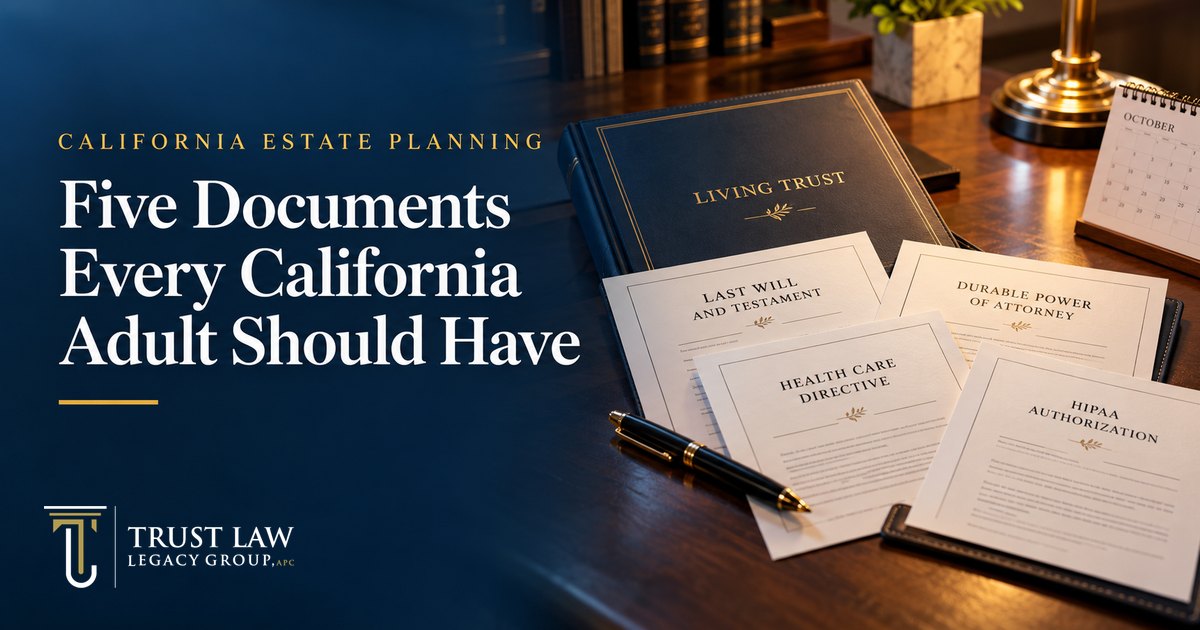
Quick Answer: Most California adults need five estate planning documents: a revocable living trust, a pour-over will, a durable power of attorney for finances, an advance health care directive, and a HIPAA authorization. The trust handles your property, the will catches anything left out, and the other three let someone act for you while you are alive. The trust only works if your assets are actually retitled into it.
Table of Contents
- Why National Estate Planning Awareness Week Exists
- The Five Estate Planning Documents That Do the Work
- Where Estate Planning Documents Usually Fail
- Do You Need a Trust, or Will a Will Be Enough?
- How to Tell Whether Your Documents Are Still Current
- A Seven-Step EPAW Checklist for Your Plan
- Frequently Asked Questions
- Key Takeaways
This guide explains the five estate planning documents that carry the weight in California. It covers how each one fails, and what a current plan looks like. It is written for adults in San Jose and Santa Clara County, whether you signed a plan a decade ago or have never signed one at all.
Why National Estate Planning Awareness Week Exists
National Estate Planning Awareness Week falls in the third full week of October each year. The House of Representatives adopted a resolution recognizing it in 2008, to help people understand what estate planning is and why it matters. In 2026 it runs from October 19 to 25. For Bay Area families the timing is useful, because the cost of having no plan tends to track home values, and home values here are high.
In California, the stakes run unusually high. For example, a home in Santa Clara County can easily push an estate into full probate, where fees follow a statutory schedule rather than the hours actually worked. Our California probate fee calculator shows how that schedule applies to an estate of your size. Families here often pay more for the absence of a plan than families elsewhere.
The National Association of Estate Planners & Councils sponsors the week and publishes consumer material at naepc.org. Still, the most useful thing you can do this week is simpler. Read the list below and find out what you already have.
This week is the reminder. A design meeting is the next step.
The Five Estate Planning Documents That Do the Work
Each document below answers a specific question. Missing one leaves a specific hole in your estate planning documents.
- Revocable living trust: holds your property, keeps the assets titled to it out of probate, and tells your successor trustee how to distribute what you own.
- Pour-over will: catches any asset that never made it into the trust, and nominates a guardian for minor children.
- Durable power of attorney for finances: lets your agent handle money matters if you cannot.
- Advance health care directive: names your medical decision maker and records your treatment wishes.
- HIPAA authorization: allows doctors to share your medical information with the people you choose.
Only the first two operate after death. By contrast, the last three matter most while you are still here. Because many people face a period of incapacity before death, those three often prove the most useful documents you will ever sign.
Where Estate Planning Documents Usually Fail
A signed plan is not automatically a working plan. In fact, the same handful of gaps appear again and again.
- The trust exists, yet the house is still titled in personal names after a refinance.
- The named agent has moved away, lost capacity, or died.
- Beneficiary forms on retirement accounts contradict the trust.
- A new property, business, or account was never added to the plan.
- Nobody knows where the originals are kept.
Funding causes the most damage. For instance, if your trust owns nothing, your family still ends up in probate court holding a beautiful binder. For that reason, we treat funding as part of the plan rather than as homework you take home. If you refinanced recently, our guide on refinancing a home held in a living trust explains how to check whether the house is still in the trust.
A binder is not a plan. Let’s make sure yours actually works.
Do You Need a Trust, or Will a Will Be Enough?
A will alone usually does not avoid probate in California, unless the estate qualifies for a small-estate procedure. Instead, it directs the court on how to distribute your estate after the process ends. Because probate is public, slow, and governed by a statutory fee schedule, most homeowners here choose a revocable living trust.
Renters with modest savings sometimes do fine with a will plus good beneficiary designations. However, once you own real property, the calculation usually changes. For a fuller comparison, read our guide on choosing between a will and a living trust.
Either way, the incapacity documents remain essential. Every parent of a minor child should nominate a guardian. California Probate Code section 1502 lets a parent make that nomination in any signed writing, so families often sign a standalone nomination as well as naming the guardian in a will.

How to Tell Whether Your Documents Are Still Current
Age alone does not make a plan invalid. Rather, change does. Run through the checkpoints below during Estate Planning Awareness Week.
- Has anyone named in your documents died, moved, or become unable to serve?
- Have you married, divorced, or added a child or grandchild?
- Did you buy, sell, or refinance any real property?
- Have you opened accounts or started a business since signing?
- Would your family know where to find everything tomorrow morning?
Two or more yes answers usually justify a review. A plan with no changes at all may still deserve a quick look every three to five years. After all, the law itself keeps moving, and your estate planning documents should keep up.
A Seven-Step EPAW Checklist for Your Plan
Set aside an hour during Estate Planning Awareness Week and work through these steps in order. Most of them need nothing more than your binder and your account logins.
- Find the originals. Locate your signed trust, will, powers of attorney, and health care directive, and confirm where the originals are kept.
- Confirm the house is in the trust. Look at the most recent recorded deed for your home. The Santa Clara County Clerk-Recorder’s Office keeps the official records for property in the county. Title should show you as trustee of your trust, not in your personal names.
- Compare beneficiary forms with the trust. Retirement accounts, life insurance, and annuities pass by their own forms. Our post on why beneficiary designations decide who really inherits walks through that review.
- Check every person you named. Confirm each trustee, agent, and health care decision maker is still alive, willing, able to serve, and still your choice.
- Check guardian nominations. If you have minor children, make sure a guardian is named and that the person still fits your family.
- List what you acquired since signing. Note new accounts, real property, a business interest, or equity compensation from an employer, and whether each one is titled to the trust or covered by a beneficiary form.
- Tell someone where the plan is. Your successor trustee should know where the documents are kept and whom to call.
If any step turns up a gap, write it down and bring the list to a design meeting. We work with families across the Bay Area from our San Jose office.
Frequently Asked Questions
What estate planning documents do I need if I am single with no children?
You still need the incapacity set: a durable power of attorney, an advance health care directive, and a HIPAA authorization. Otherwise, nobody has clear authority to help you. A will or trust then directs where your property goes.
Are handwritten wills valid in California?
California recognizes holographic wills under Probate Code section 6111 when the signature and the material provisions appear in the testator’s own handwriting. They invite disputes, often omit key provisions, and still go through probate. Treat one as an emergency measure rather than a plan.
Does a living trust avoid probate for everything I own?
Only for assets actually titled to the trust or directed to it properly. Anything left outside the trust, and not covered by a beneficiary designation or joint title, can still require probate.
Can I write my own estate planning documents from an online form?
You can, though the risk sits in what a form cannot see. For example, funding, tax elections, blended families, and property held in other states all need judgment. Unfortunately, a family usually discovers a flawed plan only when nobody can fix it anymore.
When is National Estate Planning Awareness Week in 2026?
National Estate Planning Awareness Week runs from October 19 to 25, 2026. It falls in the third full week of October each year, and the House of Representatives adopted a resolution recognizing it in 2008.
Key Takeaways
- Five estate planning documents carry the weight: a living trust, a pour-over will, a financial power of attorney, an advance health care directive, and a HIPAA authorization.
- Estate planning documents fail most often through funding, not through drafting, so check how your home is titled.
- Three of the five matter while you are alive, because many people face a period of incapacity before death.
- A will alone usually does not avoid probate in California, and probate fees follow a statutory schedule.
- Unfunded trusts cause the most damage, and a refinance is a common reason a home falls out.
- Review your plan after any marriage, divorce, birth, death, move, or property change.
- National Estate Planning Awareness Week runs October 19 to 25, 2026, which makes it a practical deadline for the seven-step checklist above.
Estate Planning Awareness Week only helps if it ends with a decision. Pull your documents this week and check them against the list above. If something is missing, outdated, or unclear, bring it to a design meeting and we will tell you plainly what needs attention. You can also review how we work with families across San Jose and Santa Clara County.
Found a gap in your plan? Fix it while it is still easy.
This article provides general information about California law and is not legal advice. Reading it does not create an attorney-client relationship. Every situation differs, and outcomes depend on facts specific to each family. Prior results do not guarantee a similar outcome.