Table of Contents
- Who Was Anna Nicole Smith?
- Why the Anna Nicole Smith Case Still Matters in California
- What Happened in the Anna Nicole Smith Probate Case?
- The California Connection: Los Angeles, San Francisco, and Probate Jurisdiction
- Lesson 1: Verbal Promises Are Not Enough
- Lesson 2: A Will Alone May Not Avoid Probate
- Lesson 3: Probate Litigation Can Last for Years
- Lesson 4: Age Gaps, Blended Families, and Unequal Inheritances Need Careful Planning
- Lesson 5: Jurisdiction Matters in Probate Disputes
- How California Families Can Avoid Similar Estate Planning Problems
- How a California Estate Planning Attorney Helps San Jose and Bay Area Families
- Common Questions About Probate and Estate Planning in California
- Final Thoughts: Celebrity Case, Real-Life Lessons
- Talk With a California Estate Planning Attorney
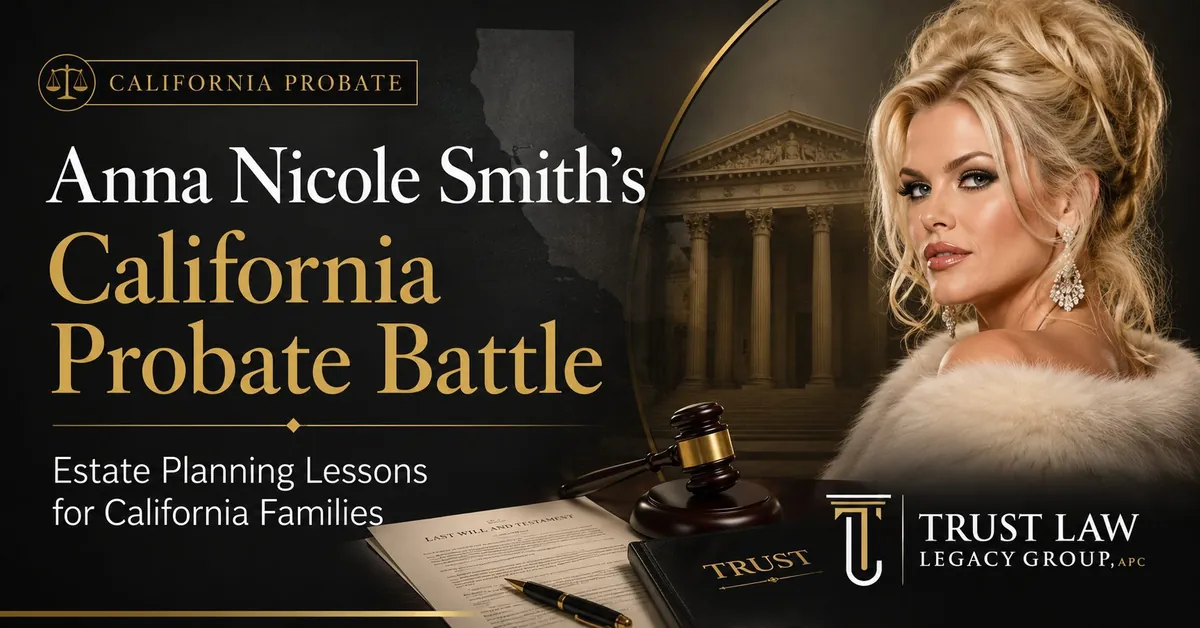
Who Was Anna Nicole Smith?
Anna Nicole Smith, born Vickie Lynn Hogan, was an American model, actress, and television personality who rose to fame in the 1990s. She became widely known as a Guess model, Playboy Playmate of the Year, and later as the star of her own reality television show.
Beyond her celebrity career, Smith became the center of one of the most famous probate and inheritance disputes in U.S. history after marrying billionaire J. Howard Marshall II shortly before his death. For estate planning professionals, her case remains a powerful example of what can happen when alleged verbal promises, written estate documents, family expectations, and court jurisdiction collide.
Why the Anna Nicole Smith Case Still Matters in California
Few probate disputes have received as much public attention as the legal battle involving Anna Nicole Smith and the estate of her late husband, J. Howard Marshall II.
Smith married Texas oil billionaire J. Howard Marshall II when she was in her twenties and he was in his late eighties. However, their marriage lasted only about 14 months before Marshall passed away.
After his death, Smith claimed that Marshall had verbally promised her a large share of his estate. However, Marshall’s written estate plan left most of his wealth to his son, E. Pierce Marshall. Consequently, that conflict launched one of the most famous estate disputes in American legal history.
Although the estate itself was tied to Texas, California played a major role. Meanwhile, Smith moved to California and filed for bankruptcy in Los Angeles. A California bankruptcy court initially awarded her hundreds of millions of dollars. Later, the case moved through federal appellate courts, including the San Francisco-based 9th Circuit Court of Appeals, before reaching the U.S. Supreme Court.
For California residents, the case is more than celebrity history. Instead, it is a powerful reminder of how unclear estate planning leads to years of litigation, emotional stress, and financial loss.
Don’t leave your family’s inheritance to chance.

What Happened in the Anna Nicole Smith Probate Case?
J. Howard Marshall II died in 1995. Indeed, his estate was worth billions, and his written estate plan largely excluded Anna Nicole Smith. Still, Smith argued that Marshall had promised her half of his estate during his lifetime.
That claim triggered competing court proceedings. A Texas probate court sided against Smith. Meanwhile, after Smith filed bankruptcy in Los Angeles, a California bankruptcy court awarded her approximately $474 million for alleged interference with her expected inheritance. However, a federal district court later reduced the award to about $88.5 million.
But the award did not last.
The 9th Circuit Court of Appeals and the U.S. Supreme Court later concluded that the bankruptcy court had gone too far. The courts addressed whether a bankruptcy court had authority to decide issues closely tied to probate and inheritance rights.
In the end, the California bankruptcy award was not enough to overcome the probate court rulings. In the end, Smith’s estate received nothing from the Marshall estate.
The California Connection: Los Angeles, San Francisco, and Probate Jurisdiction
California was central to the case because Smith filed bankruptcy in Los Angeles. Therefore, that filing let a California bankruptcy court hear her inheritance-related claims.
However, bankruptcy court is not the same as probate court.
A probate court handles matters such as wills, estate administration, beneficiary rights, Personal Representative (Executor) duties, and the distribution of assets after death. Bankruptcy court handles debts, creditors, insolvency, and bankruptcy estates.
Smith’s case raised a major legal question: Could a bankruptcy court decide an inheritance dispute connected to a probate estate?
The U.S. Supreme Court ultimately limited the authority of the bankruptcy court to enter a final judgment on certain state-law claims that were closely connected to the probate dispute.
Of course, that distinction matters for California families. Sometimes a loved one passes away and a dispute arises over a will, trust, beneficiary designation, or estate distribution. In that case, the correct court and legal strategy make a major difference. Above all, the choice belongs at the start of the dispute, not the middle.

Lesson 1: Verbal Promises Are Not Enough
One of the biggest lessons from the Anna Nicole Smith case is that verbal promises can create major problems after death.
Smith claimed Marshall promised her a large share of his estate. But the written estate documents told a different story.
As a result, in California estate planning, oral promises are often difficult to prove. After someone dies, the person who allegedly made the promise is no longer available to explain what they meant. Meanwhile, family members may disagree. Documents may be incomplete. Similarly, memories may conflict.
That is why written estate planning is so important.
By contrast, a properly prepared estate plan makes all of this clear:
- Who receives property
- Who serves as Personal Representative of the estate or Trustee of the trust
- What happens to real estate
- How personal property is distributed
- Whether certain family members are intentionally excluded
- How disputes should be handled
- What happens if a beneficiary dies first
Without clear written instructions, families may be left fighting over what the deceased person “really wanted.”
Lesson 2: A Will Alone May Not Avoid Probate
Many California families believe that having a will means their estate will avoid court. That is not always true.
A will tells the probate court how to distribute assets, but it generally does not avoid probate by itself. If assets are titled only in the deceased person’s name and do not pass by beneficiary designation, joint ownership, or trust, probate may still be required.
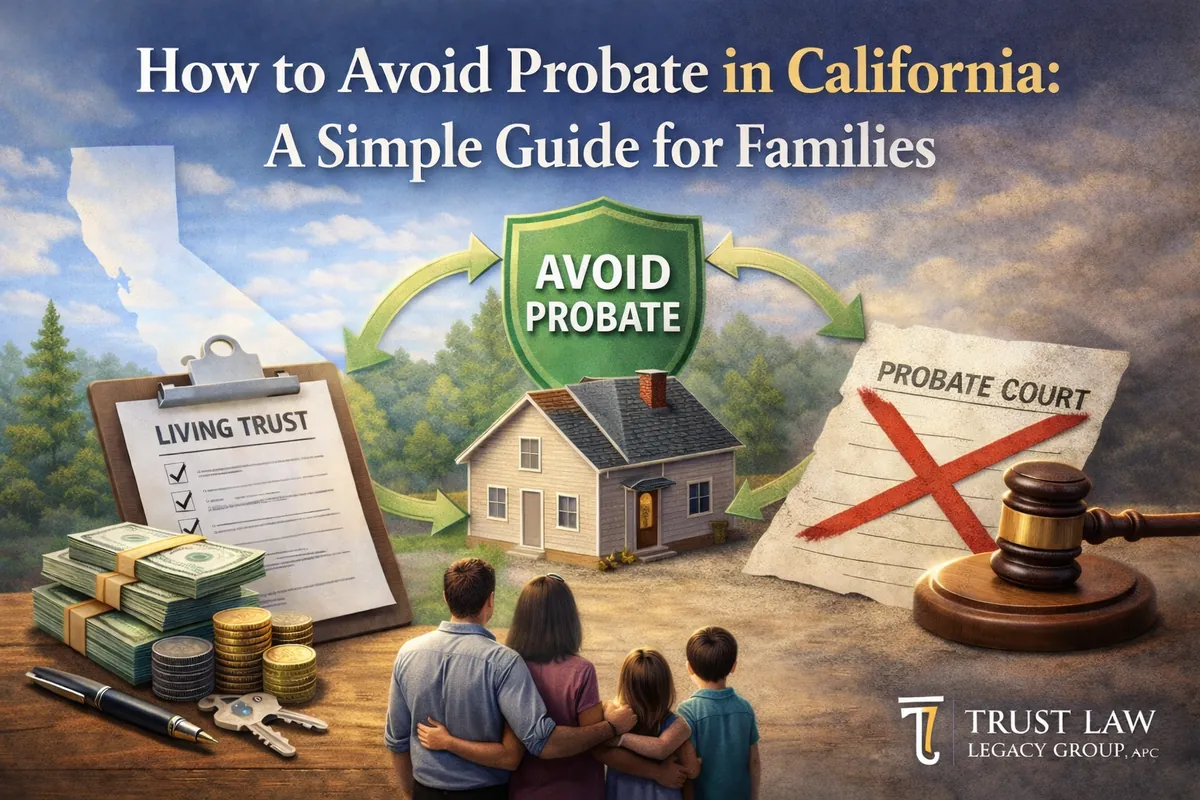
That is why many California homeowners and families use revocable living trusts as part of their estate plans.
A living trust may help:
- Avoid probate for properly funded assets
- Keep estate administration more private
- Reduce court delays
- Provide instructions if the trust creator becomes incapacitated
- Make administration easier for surviving family members
- Protect beneficiaries from confusion and unnecessary conflict
However, a trust only works properly when it is correctly drafted and funded. Placing assets into the trust is a critical step.
Lesson 3: Probate Litigation Can Last for Years
The Anna Nicole Smith estate dispute lasted for years and continued even after key people involved in the case had died. Smith and E. Pierce Marshall both died while litigation connected to the dispute was still ongoing.
That is one of the most painful realities of probate litigation: it can outlive the people at the center of the dispute.
For California families, probate conflict may involve:
- Will contests
- Trust contests
- Claims of undue influence
- Allegations of elder financial abuse
- Disputes between siblings
- Questions about capacity
- Creditor claims
- Breach of fiduciary duty by a Personal Representative or Trustee
- Disagreements over real estate
- Conflicts between surviving spouses and children from prior relationships
The more unclear the estate plan, the more room there may be for litigation.
Spare your loved ones years of probate litigation.
Lesson 4: Age Gaps, Blended Families, and Unequal Inheritances Need Careful Planning
The Smith-Marshall dispute involved a large age gap, a short marriage, adult children, and billions of dollars. Most California families are not dealing with celebrity-level wealth, but many do deal with similar planning risks.
Estate disputes often arise when there is:
- A second marriage
- Children from a prior relationship
- A much younger spouse
- A caregiver who becomes a beneficiary
- A sudden change to a will or trust
- Unequal distributions among children
- A family business
- Real estate in multiple states
- A dependent adult or vulnerable elder
- A beneficiary who expected more than they received
These situations do not automatically mean something is wrong. But they do require careful documentation and thoughtful legal planning.
A strong California estate plan can explain the client’s intentions clearly and reduce the chance that disappointed beneficiaries will challenge the plan later.
Lesson 5: Jurisdiction Matters in Probate Disputes
One of the most important legal issues in the Anna Nicole Smith case was jurisdiction. In simple terms, jurisdiction means whether a court has the power to decide a particular issue.
Smith’s case involved bankruptcy court, probate court, federal appeals, and the U.S. Supreme Court. A major part of the dispute centered on whether the bankruptcy court had authority to decide issues tied to a probate estate.
For California families, jurisdiction can become complicated when:
- A person dies while owning property in another state
- The deceased person recently moved
- Family members live in different states
- A trust was created in one state but administered in another
- Real estate is located outside California
- A beneficiary files a competing case in another court
- Bankruptcy, creditor, divorce, or business issues overlap with probate
These issues can make estate administration more complex and expensive. Proper planning can help reduce confusion before it begins.
How California Families Can Avoid Similar Estate Planning Problems
The Anna Nicole Smith case shows what can happen when expectations, promises, and documents do not align. Working with a California estate planning attorney, California families can reduce the risk of similar disputes by taking proactive steps.
1. Put Your Wishes in Writing
Do not rely on verbal promises. A legally valid estate plan should clearly explain who receives what and who has authority to act.
2. Consider a Living Trust
For many California homeowners, a revocable living trust can be an important tool for avoiding probate and simplifying administration.
3. Fund the Trust Properly
Creating a trust is only part of the process. Assets such as real estate, bank accounts, and investment accounts may need to be properly titled or coordinated with the trust.
4. Update Beneficiary Designations
Review your retirement accounts, life insurance policies, and payable-on-death accounts regularly. Assets that pass by beneficiary designation generally pass outside of a will or trust. As a result, they follow the beneficiary designation on file, regardless of contrary provisions in a will.
5. Plan for Incapacity
A complete California estate plan should address incapacity as well as death. Powers of attorney and advance health care directives can help trusted people make decisions if you cannot.
6. Document Unusual Decisions
If you plan to disinherit someone, leave unequal gifts, benefit a caregiver, or make major late-life changes, careful documentation can help reduce future disputes.
7. Review Your Plan After Major Life Changes
Estate plans should be reviewed after marriage, divorce, death of a loved one, birth of a child, purchase of property, business changes, relocation, or major financial changes.
How a California Estate Planning Attorney Helps San Jose and Bay Area Families
California families, especially homeowners in San Jose, Santa Clara County, Fremont, Alameda County, and the greater Bay Area, often have significant assets tied to real estate. Without proper estate planning, those assets may become subject to probate, delay, expense, and potential disputes.
The Anna Nicole Smith case reminds us that estate planning is not only for celebrities or billionaires. It is for anyone who wants to make their wishes clear, protect loved ones, and reduce the risk of conflict.
Whether your estate is simple or complex, the same principle applies: clear documents prepared with a California estate planning attorney can prevent confusion.
Common Questions About Probate and Estate Planning in California
What is probate in California?
Probate is the court-supervised process for administering a deceased person’s estate, whether the decedent died with a will (testate) or without a will (intestate). It may involve validating a will, appointing a personal representative, notifying creditors, paying debts, and distributing assets to heirs or beneficiaries.
Does a will avoid probate in California?
Usually, no. A will can guide probate, but it generally does not avoid probate by itself. A properly drafted and properly funded revocable living trust may help avoid probate for assets titled in the trust.
Why is a living trust important for California homeowners?
California real estate can trigger probate if you own it solely in your name at death. A properly funded living trust may allow real estate to transfer without a full probate court process.
Can verbal promises override a will or trust?
Verbal promises concerning inheritance rights are generally difficult to prove and enforce. California courts typically place substantial weight on properly executed written estate planning documents. A written, legally valid estate plan is usually far stronger than an alleged oral promise.
What causes probate disputes?
Common causes include unclear documents, blended families, suspected undue influence, capacity concerns, unequal inheritances, missing assets, Trustee-beneficiary disputes, and last-minute estate plan changes.
When should I update my estate plan?
You should review your estate plan after major life events. These include marriage, divorce, death of a loved one, birth of a child, purchase of property, business changes, or relocation to another state.
Final Thoughts: Celebrity Case, Real-Life Lessons
The Anna Nicole Smith probate battle may have involved a celebrity, a billionaire, and hundreds of millions of dollars, but the core lesson applies to everyday California families.
Estate planning is not just about wealth. It is about clarity, protection, and peace of mind.
When wishes are not clearly written, families can end up in court. Incomplete documents can leave beneficiaries fighting among themselves. If a trust is never funded, probate may still be required. And where verbal promises conflict with written documents, years of litigation can follow.
A thoughtful California estate plan can help protect your family, your home, your legacy, and your intentions.
Talk With a California Estate Planning Attorney
At Trust Law Legacy Group, APC, our California estate planning attorneys help families create clear, customized estate plans designed to protect loved ones and reduce unnecessary court involvement.
Whether you need a living trust, will, probate guidance, trust administration support, or a complete estate planning review, our team can help you understand your options and plan with confidence.
Tomorrow’s peace starts with today’s plan. Schedule a design meeting with Trust Law Legacy Group to discuss the right estate planning strategy for your family.
Give your family clarity, protection, and peace of mind.
Contact Trust Law Legacy Group, APC
| Phone: | 408-945-3950 |
| Email: | admin@trustlawlegacy.com |
| Website: | https://trustlawlegacy.com |
| San Jose Office: | 100 Century Center Ct., Ste. 620, San Jose, CA 95112 |
Final Disclaimer
This blog is provided for educational purposes only and is intended to remind readers of the importance of proper estate planning, probate guidance, trust administration, and related legal services. It is not legal advice and does not create an attorney-client relationship. For guidance about your specific situation, consult a qualified California estate planning attorney.
Quick Answer
The Anna Nicole Smith probate case shows why any California estate planning attorney will tell families not to rely on verbal promises, informal understandings, or unclear estate plans. Although Smith initially won a massive award in a Los Angeles bankruptcy court, that ruling was later challenged and ultimately rejected. The final result was that her estate received nothing from J. Howard Marshall II’s estate.
For California families, the lesson is clear: a properly written estate plan can help protect loved ones, reduce court involvement, and avoid years of expensive conflict.
Disclaimer
This blog is for educational and informational purposes only. It is designed to help California families better understand the importance of proper estate planning, probate avoidance, trust administration, and related legal services. It should not be taken as legal advice for any specific situation.
Every family, estate, and legal matter is different. Do you have questions about your own estate plan, trust, probate matter, or inheritance concerns? Then speaking with a qualified California estate planning attorney can help you understand your options and protect your loved ones.
Key Takeaways
- Verbal promises are difficult to enforce after death.
- A written will or trust usually carries more legal weight than private conversations.
- Probate disputes can last for years or even decades.
- Bankruptcy courts and probate courts serve different legal purposes.
- A living trust may help California families avoid probate and maintain privacy.
- Clear estate planning can reduce the risk of family conflict, creditor issues, and litigation.