

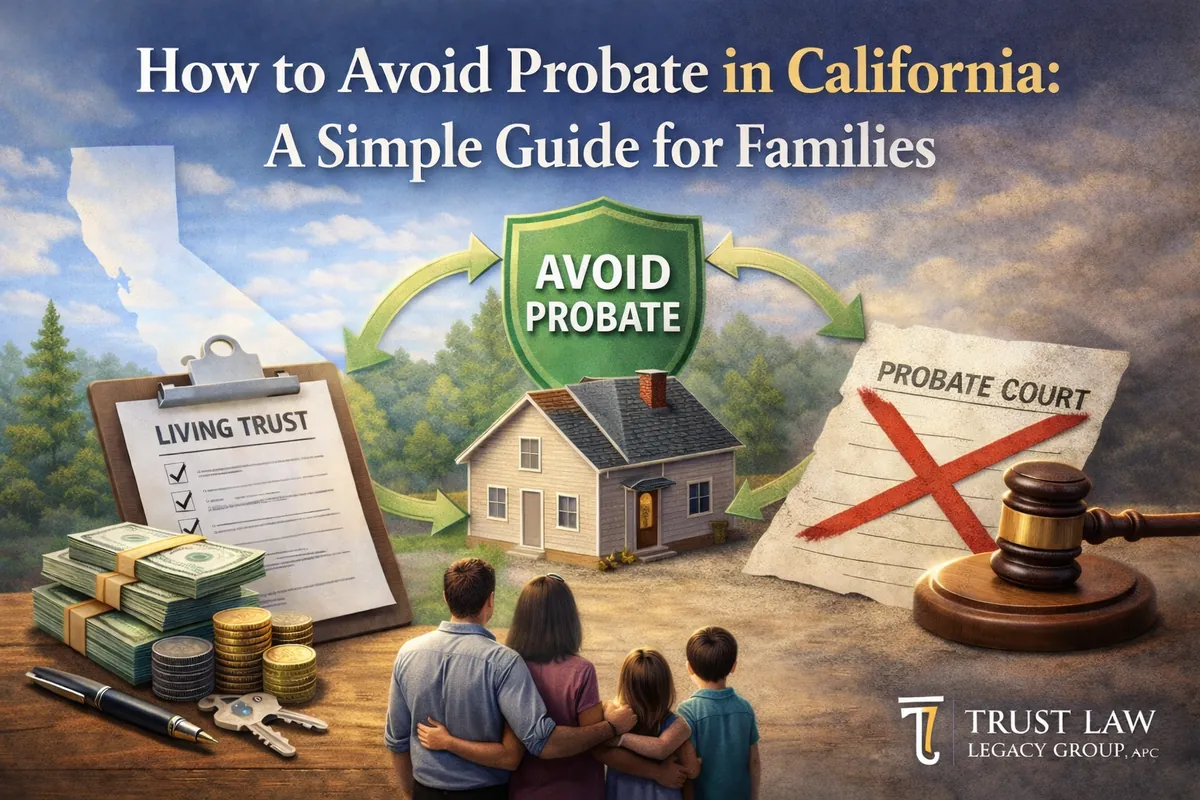
Probate is not a penalty for dying without a plan. It is simply the court process California uses to move property whose title has nobody left to sign it. Avoiding it is a titling exercise, and it is almost entirely done while you are alive.
Written by Trust Law Legacy Group, APC, an Estate Planning, Trust & Probate Law Firm in San Jose, California. Updated August 2026.
Quick Answer: Probate applies to assets that are titled in your name alone with no surviving co-owner and no named beneficiary. You avoid it by changing that: fund a living trust, add beneficiary designations, and check how the deed on your home actually reads. A will does not avoid probate. It is instructions to the probate court.
Table of Contents
What Actually Triggers Probate
Ask one question about each thing you own: when I die, whose name is on this, and who does it go to automatically?
If the answer is “mine alone, and nobody,” that asset is heading for probate. If it is held by a trust, owned jointly with a survivor, or carries a beneficiary designation, it is not. That is the whole test.
This is why probate catches families who thought they had planned. They signed a trust in 2015, then bought a rental in 2019 in their own names, then refinanced the house in 2022. The document was fine. The titling drifted.

What California Probate Costs
California is one of the few states that sets attorney and executor compensation by statute, as a percentage of the gross value of the probate estate. Gross, not equity. The mortgage does not reduce the fee.
On a $1M gross estate, that is roughly $23,000 in statutory attorney fees and an equal $23,000 to the personal representative, plus court costs, probate referee fees, and publication costs. In Santa Clara County the typical case runs 12 to 18 months, and the statutory minimum is about eight months even when nothing goes wrong.
The file is also public. Anyone can read what the estate held and who received it.
The Five Ways Property Passes Outside Probate
1. A funded living trust
The workhorse, and the only one of the five that handles everything in a single structure. You re-title assets into the trust, name a successor trustee, and that person distributes them without a court. It also covers incapacity, which none of the other four do. See how a will and a living trust compare before deciding.
2. Beneficiary designations
Retirement accounts, life insurance, and payable-on-death or transfer-on-death accounts pass by contract to whoever is named on the form. Probate Code section 5000 confirms these transfers are valid even though the form is not executed like a will.
The catch is that the form beats your will and your trust. A retirement account still naming an ex-spouse goes to the ex-spouse. Contingent beneficiaries are the ones most often left blank, and they matter precisely when the primary has already died.
3. Joint tenancy with right of survivorship
Property held in joint tenancy passes to the surviving owner outside probate. It is simple, and it is over-used.
Adding an adult child to the deed exposes the property to that child’s creditors and divorce, can create a taxable gift, and gives up part of the basis step-up your family would otherwise get. It also only postpones the problem: when the survivor dies, the asset is back in a single name with no plan behind it.
4. Community property with right of survivorship
A California option for married couples that combines survivorship with community property treatment. It avoids probate on the first death and preserves favorable basis treatment, but it does nothing for the second death, and nothing for incapacity.
5. Simplified procedures for small estates
California offers an affidavit procedure for estates under a statutory dollar limit, plus a spousal property petition that lets a surviving spouse confirm property without a full probate. Useful, and unlike the small-estate affidavit it has no dollar cap, so it can work even when a Bay Area home is in the estate.
Not sure which of these your house is actually held under? That is the first thing we check.
Why a Will Does Not Help
This is the single most common misunderstanding we hear in a design meeting.
A will does not avoid probate. It is essentially a set of instructions to the probate court about how to distribute the assets that go through probate. Having one means the judge follows your plan instead of the intestacy statute. It does not keep you out of the courtroom, and it does nothing at all if you become incapacitated while you are still alive.
You still want one. A short pour-over will catches anything you never moved into the trust, and for parents it is the only document that nominates a guardian for minor children.
If there is no will or trust, see who inherits without a will in California.
Where Plans Fail: Funding
A signed trust with nothing in it is a probate waiting to happen. Four failure modes account for most of what we see:
- The refinance: many lenders require the property to come out of the trust to close, and unless a deed is recorded afterward putting it back, the house sits outside the plan. Check the recorded deed, not the binder copy.
- The account opened later: anything you opened after signing was almost certainly opened in your own name.
- Out-of-state property: real property in another state can trigger a second probate there, in a plan otherwise designed to avoid one.
- The stale beneficiary form: still naming a parent, an ex-spouse, or someone who has died.

For a house that is not yet titled in your trust, see our real estate attorney in San Jose page.
A Thirty Minute Self Check
You can do the first pass yourself, without a lawyer:
- Pull the recorded deed for every property you own and read the vesting line. Does it name the trust?
- Log in to each bank and brokerage account. Does the registration show the trust as owner?
- Open every retirement and life insurance account and read the primary and contingent beneficiary.
- List any business interest, and check whether the operating agreement or share register names the trust.
- Write down anything that answers “mine alone, and nobody.” That list is your probate exposure.
Most families find at least one surprise. A fuller version of this inventory is here.
When you are ready to put this into a written plan, meet with an estate planning attorney in San Jose at our firm.
Frequently Asked Questions
Can I avoid probate without a trust?
Sometimes. Beneficiary designations, survivorship title, and the small estate procedures all work on their own. The gap is that none of them handle incapacity, none of them let you stage a distribution over time, and coordinating them across a dozen accounts is where mistakes creep in.
How long does California probate take?
The statutory minimum is about eight months. In Santa Clara County the typical range is 12 to 18 months, and a contested matter runs longer.
Does a trust avoid estate tax?
A revocable trust does not. Its assets remain in your taxable estate. For most California families that is moot anyway: the 2026 federal exemption is $15 million per person and California has no state estate tax.
When should I review the plan?
After buying or refinancing property, opening significant accounts, marriage or divorce, a birth, an inheritance, or a move out of California. Otherwise every three to five years.
About the Firm
Trust Law Legacy Group, APC is an estate planning, trust, and probate law firm in San Jose, California, serving families across Santa Clara County and the greater Bay Area. Our team includes a Certified Specialist in Estate Planning, Trust and Probate Law, The State Bar of California Board of Legal Specialization.
This article is general information about California law, not legal advice, and reading it does not create an attorney-client relationship. Every family’s situation is different. Talk to a lawyer about yours.
If a loved one has passed and probate may be required, see how our San Jose probate attorney team guides families through the court process.